
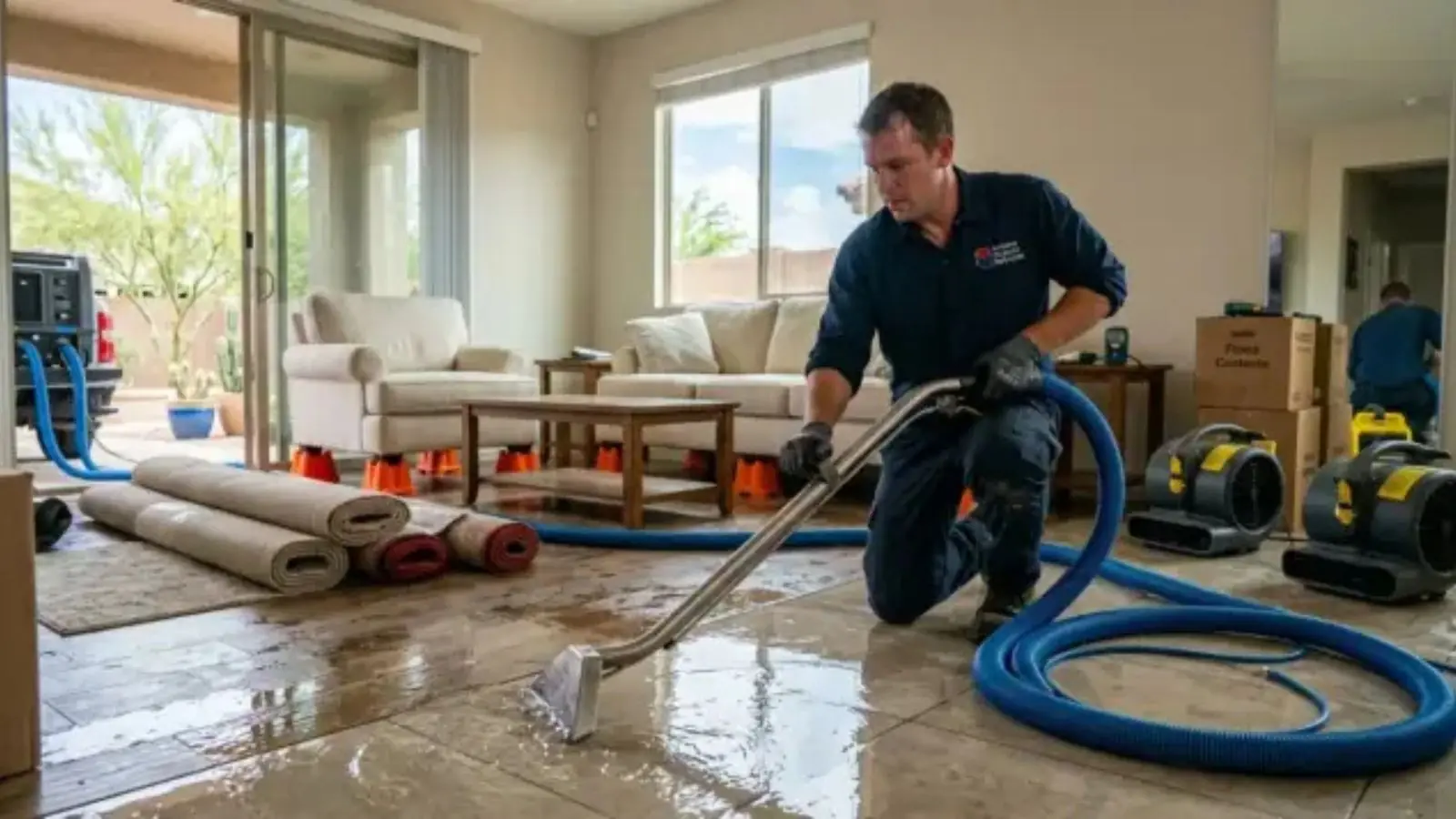
Water Damage Restoration in Wheat Ridge, CO
Water damage restoration in Wheat Ridge, Colorado means stopping the water, drying the structure and documenting the loss before mold gets a start. Dispatch is open 24/7 for burst pipes, sewage backups, creek and storm flooding and wet basements across Wheat Ridge, Arvada, Denver and Golden.
- Licensed and insured
- Scope and price explained first
- 24/7 dispatch
Wheat Ridge Dispatch Snapshot
Active water, a failed pipe or a sewage backup?
Someone picks up around the clock, on nights, weekends and holidays alike.
Water Damage Restoration, Done in the Right Order
Water damage restoration is the work of stopping the water, removing what is wet, drying the structure and documenting the loss so repairs can start on dry material.
In Wheat Ridge that usually means a basement that took on water, a ceiling stained by a roof leak, a supply line that let go behind a wall, or a sewer line that backed up through a floor drain. The order matters, because wet drywall and framing can start growing mold if the drying is delayed, and the EPA's mold guidance gives only a day or two to get things dry.
We run the job in four stages: emergency response, extraction and drying, cleanup and sanitizing, and repair. Each stage has its own page below, so you can read about the one you are standing in right now. If you are not sure which stage you need, call the 24/7 line and describe what you see. The dispatcher will sort the situation and tell you what to do while you wait.
Water Damage Repair
Rebuilding drywall, insulation, flooring and paint once the structure is dry. This is the page for ceilings, walls and floors that need to be put back together.
Emergency Water Removal
Standing water pumped out right now, whatever the source.
Flood Damage Restoration
Creek, storm and groundwater flooding, plus basement flooding and sewage backups that need Category 3 handling.
Water Mitigation
The first 24 to 72 hours: shut-off, moisture mapping, drying equipment setup and structural drying.
Water Damage Cleanup
Soaked debris hauled out, then the space is sanitized and deodorized.
Mold Remediation
Containment, removal and clearance after moisture has let mold grow. Secondary service, with full detail on its own page.
What Puts Wheat Ridge Properties at Risk
Wheat Ridge maps three floodplains inside city limits. The biggest belongs to Clear Creek, which crosses the north end of town through the Greenbelt. Lena Gulch comes in from the southwest and meets Clear Creek near Kipling. The third trails 26th Avenue from Wadsworth to Sheridan, and there the city notes that storm sewers and streets carry most of the water.
The practical point is that you do not have to live beside a creek to get water. The county itself cautions that floods often happen beyond the mapped zones, and street-level runoff along a corridor like Wadsworth Boulevard can find a window well just as easily. A basement near 26th Avenue and a house near the Greenbelt face different water paths, so we ask where the water entered before we pick equipment.
Hail adds a second path. In the May 2017 storm, National Weather Service reports put 1.75 inch stones in both Golden and Wheat Ridge, and hail-bruised roofs are a common reason a ceiling starts to stain months later. If you notice a brown ring on a ceiling after a storm, treat it as an active leak and call before the drywall softens.
Then there is plumbing and sewers. Several water districts serve the city, including Consolidated Mutual, Valley Water, Denver Water and the Wheat Ridge Water District, and wastewater in the northwest part of the city is collected by the Fruitdale Sanitation District. Knowing which provider serves your address tells you who to call to shut off or check the supply at the street.
From the First Call to a Dry, Documented Home
Call Dispatch
Tell us what you see and where. We give you safe steps to take while a crew is arranged.
Assess and Scope
Moisture meters and thermal imaging map where the water went. You get the scope and price explained before work starts.
Extract and Dry
Pumps and extraction units remove water. Air movers and dehumidifiers dry the structure with logged readings.
Clean and Repair
Wet debris is removed, surfaces are sanitized, and repairs are scheduled once the material tests dry.
Every step produces paper. Moisture readings, photos and a written scope are the records your insurer will ask about, and they also tell you when drying is truly finished instead of just looking finished. Ask any company you consider, including us, to show its drying logs before it takes the equipment out.
What to Do While Water Is Still Spreading
Stop the source
Close the main valve when a supply line is the source. Do not wade into water that may touch outlets or an electrical panel.
Protect people first
Switch off power to wet rooms only when the panel itself is dry and close at hand. If you smell gas or see sparks, leave and phone the utility or 911 first.
Lift what you can
Move rugs, small furniture and electronics out of the wet area. Leave heavy furniture where it stands.
Document everything
Take wide and close photos and a short video before anything is moved. Start a list of damaged items for your insurer.
Keep children and pets out of any water that came from a toilet, a sewer line or a creek. That water carries contamination, and it needs a different cleanup than a clean supply-line leak. If you are unsure, assume it is contaminated and call.
Why the Source of the Water Changes the Job
The published industry standard for water damage restoration, ANSI/IICRC S500, sorts water by how contaminated it is. The category decides what can be dried in place and what must be removed. Ask any company you hire whether its crews work to S500.
| Category | Typical source | What it usually means for the job |
|---|---|---|
| Category 1 | Broken supply line, tub or sink overflow with clean water | Dry in place when caught quickly. Porous materials may still need removal if they stayed wet too long. |
| Category 2 | Washing machine or dishwasher discharge, sump pump failure | Carpet pad and soaked porous material usually come out. Hard surfaces are cleaned and sanitized. |
| Category 3 | Sewage, creek or storm floodwater, long-standing water | Heavy contamination. Affected porous materials are removed and the area is sanitized and cleared. |
Clean water becomes worse water as it sits. A Category 1 supply-line leak left for days can behave like a Category 2 or 3 loss, which is one more reason to call early. Our page on flood damage restoration covers the contaminated end of this table in more depth.
Not sure what category you have?
Call and describe the source. We will tell you what to do next.
Cost Factors We Explain Before Work Begins
Nobody can price a water loss over the phone, and we do not guess. The price is set by what the water touched and how long it sat. We walk the property, take readings, and explain the scope and price before work starts.
Water category
Clean, gray or contaminated water changes the labor, the disposal and the sanitizing steps.
Area and depth
More rooms and more square footage mean more extraction and more drying equipment.
Materials involved
Hardwood, carpet, drywall, insulation and cabinets each dry or fail differently.
Drying time and equipment
Air movers, dehumidifiers and monitoring visits scale with the size and humidity of the loss.
Rebuild scope
Removal of wet drywall or flooring leads to repair work, which is priced separately from drying.
Time since the loss
Water left standing spreads into more materials and raises the chance of mold.
Insurance and Your Claim
Homeowners policies tend to respond to a sudden pipe failure and tend to push back on slow leaks or neglect. Flood damage is usually excluded and needs its own policy. Read your policy, then call your insurer. State guidance from the Colorado Division of Insurance is to report the loss early, keep the damage from spreading and get your insurer's instructions before repairs begin.
Service Area: Wheat Ridge, Arvada, Denver and Golden
Dispatch runs from 3900 Wadsworth Blvd in Wheat Ridge, ZIP 80033. Arvada is about two miles north of that address as the crow flies, central Denver is roughly five miles east southeast, and Golden is a little under eight miles due west. Each town has its own page with the ZIP codes, water providers and local water risks we see there.
In Wheat Ridge we serve 80033 and the neighboring streets that carry the Wheat Ridge name. Beyond the city line, Arvada water damage restoration covers ZIP codes 80002 through 80005 and 80007, Denver water damage restoration covers west and central Denver ZIP codes such as 80211 and 80204, and Golden water damage restoration covers 80401 and 80403.
Wheat Ridge Water Damage FAQs
Do you handle water damage emergencies at night or on weekends in Wheat Ridge?
Yes. Dispatch never closes. Call, describe where the water is coming from, and we will tell you which steps are safe to take while a crew is arranged. Crews go out in the order calls come in, and no arrival time is promised.
How is the price decided?
Cost follows five things: how clean the water was, how much of the building got wet, what the wet materials are, how long drying takes and how much rebuilding follows. You see the written plan and its price before any equipment is set. We do not quote exact prices by phone because the readings on site decide the work.
Will my homeowners insurance pay for this?
It depends on the policy and the cause. A burst pipe is treated differently from a slow drip, and rising flood water usually falls under a separate flood policy. We document the loss with photos and moisture readings, and your insurer decides what is covered.
How fast can mold start after a leak?
Federal mold guidance sets a one to two day window for drying wet materials. If the water has already sat longer than that, call. Our mold remediation page explains what inspection and removal involve.
Is water damage restoration the same as waterproofing?
No. Restoration dries and repairs a building after water got in, and it does not stop water from getting in again. If water keeps entering a basement, you also need a drainage or waterproofing specialist, and we will tell you so honestly.
What equipment do you use to dry a house?
Air movers push dry air across wet surfaces, and dehumidifiers pull moisture out of the air. Moisture meters and thermal imaging show where water is hiding, and extraction units remove standing water. Readings are logged each visit so drying is measured instead of guessed.
Do you cover every ZIP code in Wheat Ridge?
We serve ZIP code 80033 and the Wheat Ridge addresses around it, and we also dispatch into Arvada, Denver and Golden. If you are unsure whether your address is covered, call and give the street address.
Water spreading right now?
Call dispatch any hour. Tell us what you see and we will start with the safest next step.
☎ Call (303) 952-8295